
Last Updated: November 4, 2026
Quick Summary
A headlight restoration warranty is a written promise about how long the restored result lasts and what the provider will do if it fails. Coverage depends on the exact terms, so compare whether each warranty covers workmanship, the product, or both before you pay.
- Workmanship warranties cover labor, while product integrity warranties cover the sealant or coating.
- A "limited" warranty can restrict the remedy, time window, parties covered, or conditions.
- Many lifetime warranties require inspections, approved aftercare products, or end when the vehicle is sold.
- Standard auto insurance generally does not cover oxidation, which is usually treated as wear and tear.
- Ask providers to confirm the warranty terms in writing before you book.
Table of Contents
- Workmanship vs. Product Integrity Warranties
- Limited vs. Lifetime Warranty Terms Side by Side
- How Long Does Headlight Restoration Last Under Colorado Conditions?
- Professional Restoration vs. DIY Kits: What the Warranty Tells You
- How a Warranty Claim Works, Step by Step
- Checking Insurance and Inspection Coverage Before You Book
- Booking Your Restoration and Re-Restoration Guarantee
- Frequently Asked Questions
Headlight restoration warranties sound simple until you read the fine print. A "lifetime" promise can mean very different things depending on what the company actually guarantees.
A headlight restoration warranty is a written promise about how long the result will last and what the provider will do if it fails. Coverage is only as good as its terms, so read them before you pay.
Workmanship vs. Product Integrity Warranties
Workmanship warranties cover the labor: sanding, polishing, and sealing done correctly. If the clear coat peels because the prep was poor, a workmanship warranty should cover a free re-restoration. Product integrity warranties cover the sealant or coating itself, promising it will resist yellowing and haze for a set period. Many providers offer one and not the other, so ask which one you are getting.
Look for these details in the warranty document:
- Whether it covers labor, materials, or both
- The exact duration, stated in years or miles
- Who pays for re-restoration and whether travel is included
Normal Wear and Tear Exclusions
Nearly every warranty excludes normal wear and tear. Road debris, hail, and gradual UV exposure are common exclusions, and they are exactly what most headlights face in Colorado. Ask the provider to define normal wear in writing. A clear warranty explains what it covers in plain language, and a vague one leaves the decision to the company when you file a claim.
Limited vs. Lifetime Warranty Terms Side by Side
A "limited lifetime" warranty and a plain "lifetime" warranty are not the same thing, and the difference matters more than the headline duration. A limited warranty restricts what the provider must do, who is covered, or under what conditions the promise survives. A full warranty, by contrast, carries fewer conditions and broader obligations. Most headlight restoration offers you will see are limited warranties, even when the marketing says "lifetime."
Here is what to compare when you line up two offers:
| Term | Limited Warranty | Lifetime Warranty |
|---|---|---|
| Duration | Fixed period, often 1-3 years | Stated as "lifetime," check conditions |
| Transferability | Often void on sale | May transfer, confirm in writing |
| Claim process | Proof of service required | Often requires inspection first |
| Exclusions | Wear, debris, environment | Same, plus maintenance conditions |
| Remedy | Re-restoration or partial refund | Repair, replace, or prorated credit |
| Maintenance | Usually none required | Often requires scheduled inspections |
What 'Limited' Actually Limits
The word "limited" is doing real work in a warranty document. It can limit the remedy (re-restoration instead of a refund), the time window (a fixed number of years even if the label says lifetime), the parties (original purchaser only), or the conditions (annual inspections, approved cleaners, garage parking). A warranty can be limited in all four ways at once.
The Legal Distinction Between 'Limited' and 'Full'
Under the federal Magnuson-Moss Warranty Act, a written warranty must be labeled as either "full" or "limited." A full warranty must meet minimum federal standards: it must cover anyone who owns the product during the warranty period, provide service without charge, and give the consumer a choice of refund or replacement if the product cannot be fixed after a reasonable number of attempts (the FTC).
How to Read the Conditions That Shorten a 'Lifetime'
A lifetime warranty that voids on your first claim or on a missed maintenance visit can be worth less than a clear 3-year limited warranty. Read the conditions before you assume the longer term is better. The conditions that most often shorten a lifetime promise are:
- Required inspections. Some providers require an annual or semi-annual inspection, and a missed visit voids coverage. Ask whether the inspection is free and whether it must be done in person.
- Approved aftercare products. Using an abrasive cleaner or a non-approved polish can void the warranty. Get the approved list in writing.
- Transfer restrictions. Many lifetime warranties end when the vehicle is sold. If you plan to sell within a few years, a transferable limited warranty may be worth more than a non-transferable lifetime one.
Watch out: A warranty that requires you to pay for inspections, shipping, or a service fee to file a claim is not free coverage, even if the re-restoration itself is covered. Add up those costs before you compare it to a shorter warranty with no fees.
Questions to Ask Before You Accept Either Term
Put these questions to any provider before you book, and ask for the answers in writing:
- Is this a full or limited warranty under Magnuson-Moss?
- What is the exact remedy if the lens fails: re-restoration, refund, or prorated credit?
- Does coverage transfer if I sell the vehicle?
- What maintenance or inspections are required to keep coverage active?
- Who pays for travel, shipping, or service fees on a claim?
- What specific conditions void the warranty?
A provider who cannot answer these questions in writing is offering a marketing promise, not a warranty. The comparison table above is only a starting point; the conditions behind each row are what determine whether the warranty is worth anything when you actually need it.
How Long Does Headlight Restoration Last Under Colorado Conditions?
Restoration typically lasts as long as the UV protective layer stays intact. In Colorado, high-altitude sun and temperature swings can shorten that life, so durability depends heavily on the sealant used and how the lens is maintained.
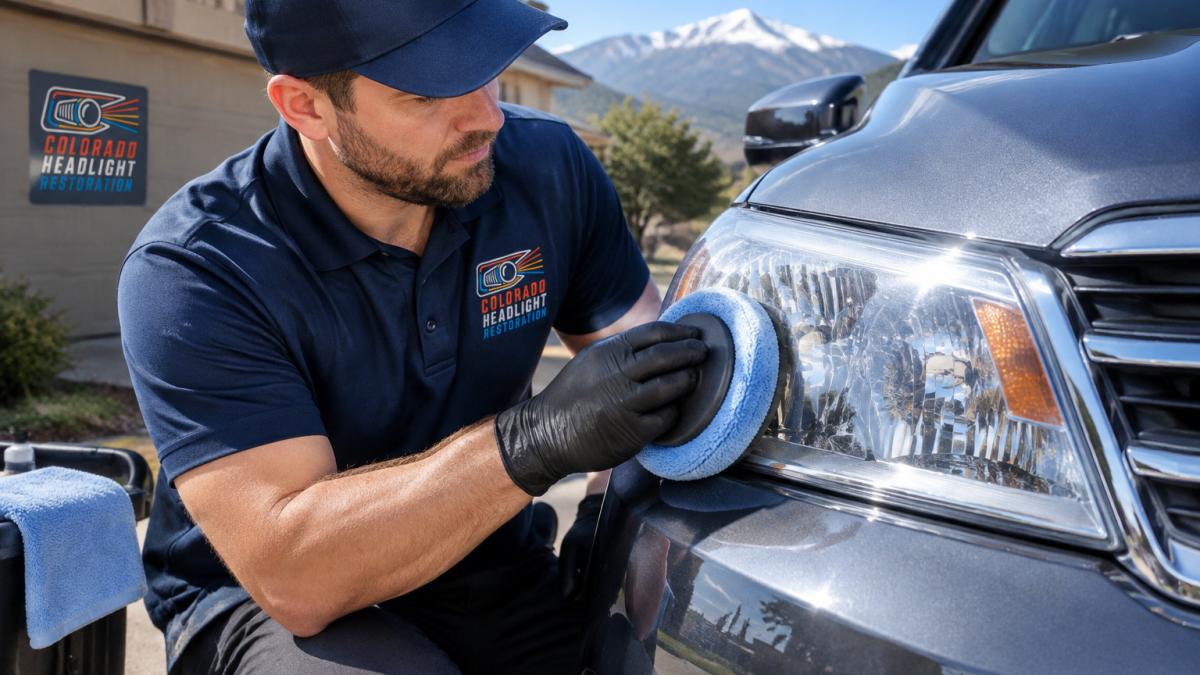
Colorado drivers face more UV exposure than many parts of the country. For that reason, the sealant and the warranty term matter more here than they might elsewhere.
The Role of UV Clear Coat and Sealant Durability
Polycarbonate headlight lenses oxidize when the UV-resistant coating breaks down. A quality restoration includes a protective sealant designed to slow that process. Ask what sealant is used, how it is applied, and what testing supports its claimed lifespan. Vague answers about "premium coatings" are a warning sign.
Environmental Factors That Can Void a Warranty
Some warranties are voided by conditions outside the provider's control. Common examples include:
- Abrasive cleaning or polishing done after the restoration
- Parking the vehicle in conditions the warranty excludes
- Impact damage from hail or road debris
Keep your aftercare instructions and a record of any cleaning you do. If a claim is denied, that record is your evidence.
Professional Restoration vs. DIY Kits: What the Warranty Tells You
DIY restoration kits are inexpensive and can improve cloudy lenses in the short term. Results from some kits can fade quickly, which is one reason to compare what sealant and warranty each option includes.
A kit gives you a process, while a warranty gives you a written commitment. If a provider cannot explain its warranty terms in writing, treat that as a reason to look elsewhere.
How a Warranty Claim Works, Step by Step
Filing a claim is easier when you know the process before you need it. Most providers follow a similar sequence:
- Document the problem. Take dated photos showing the haze, yellowing, or peeling.
- Check the terms. Confirm the warranty is still active and the issue is not excluded.
- Contact the provider. Send the photos and your original invoice or service record.
- Schedule an inspection. Many claims require the provider to examine the lens first.
- Get the decision in writing. Ask for approval or denial with the specific reason.
If a claim is denied, ask which clause the decision relies on. You can then compare that clause against the written terms and push back if the exclusion does not apply.
Checking Insurance and Inspection Coverage Before You Book
Standard auto insurance generally does not cover oxidation, which is usually classified as wear and tear rather than a covered loss. Check your own policy's definition of wear and tear. That distinction is the one most drivers miss: comprehensive coverage may pay to replace a headlight that was broken in a covered event, such as a collision, vandalism, or a hail storm, but it generally will not pay to restore a lens that simply yellowed over time.
How Insurers Typically Classify Headlight Damage
A common pattern among insurers is to treat the following as covered losses under comprehensive or collision coverage, subject to your deductible:
- Impact damage from road debris, gravel, or a collision
- Hail or storm damage that cracks or pits the lens
- Vandalism or theft-related damage
By contrast, the following are usually treated as maintenance or wear and are not covered:
- UV oxidation, yellowing, or haze
- Surface scratches from normal driving
- Peeling clear coat that failed over time
If a covered event damaged one headlight and the other is merely oxidized, the insurer will typically pay only for the damaged unit. Ask the adjuster to document the cause in writing, because that record matters if you later file a warranty claim with a restoration provider.
The Deductible Math
Even when a claim is covered, your deductible may exceed the cost of a professional restoration. If your comprehensive deductible is $500 and a restoration costs less than that, filing a claim may not make financial sense, and it could affect your claims history. Run the numbers before you call your insurer: compare the deductible against the out-of-pocket cost of restoration and against the cost of a new headlight assembly, which is often substantially higher.
Inspection Requirements and Headlight Clarity
Inspection requirements are a separate question from insurance. Inspection rules vary by state and sometimes by county, so confirm the current standard with your state motor vehicle agency before you book.
Watch out: A restoration that improves appearance but leaves the beam pattern out of spec can still fail an inspection. Ask any provider whether beam alignment and pattern are checked after restoration, not just lens clarity.
What to Confirm Before You Book
Before you schedule service, confirm three things in writing: whether your policy excludes oxidation, what your deductible is relative to the cost of restoration, and what your state inspection requires for headlight clarity. A provider who understands those three points can tell you whether restoration is the right spend or whether a replacement is the better path under your coverage.
Booking Your Restoration and Re-Restoration Guarantee
Before you book, put three questions to any provider: what the warranty covers, how long it lasts, and what it costs to make a claim. At Colorado Headlight Restoration, our service comes to your home or office and takes about 30-60 minutes, and every restoration includes a ceramic UV sealant designed for up to three years of protection. We also offer a one-year free re-restoration guarantee, so you know what happens if something goes wrong. Book your headlight restoration today, or review our truck and SUV headlight restoration options if your vehicle is a larger model.
For the full picture on what to expect, you can also read our guide on how to remove ice from headlights safely, which covers the everyday care that helps protect the lens between service visits.
Frequently Asked Questions
How long should headlight restoration last?
Results depend on the sealant, exposure, and how the lens is maintained. Colorado Headlight Restoration uses a ceramic UV sealant designed to hold up to high-altitude sun for up to three years, and the service includes a one-year free re-restoration guarantee. Harsh conditions such as hail, road debris, and daily sun exposure can shorten clarity over time. Ask any provider to put its sealant lifespan and guarantee terms in writing before you book, so you know exactly what protection you are getting.
Are headlight restorations covered under a warranty?
Many providers offer some form of warranty, but coverage differs. A workmanship warranty covers the quality of the restoration labor, while a product warranty covers how the sealant performs. Standard vehicle warranties generally do not cover cosmetic lens oxidation or normal wear. Read the terms for what triggers a claim, how long coverage lasts, and whether environmental exposure is excluded.
Do DIY headlight restoration kits come with a warranty?
Most DIY kits do not include a service warranty, since the manufacturer has no control over how the work is performed. Some kit makers offer a product satisfaction guarantee, but it typically covers only the materials, not the finish. A professional warranty usually carries more accountability for the result.
What should I do if my restored headlights turn yellow again within the warranty period?
Contact the provider as soon as you notice yellowing and keep your original service receipt. Take clear photos of the lens to document the condition. Most guarantees require you to report the issue within the coverage period and may ask you to confirm the vehicle was not damaged by an accident or harsh chemicals. Colorado Headlight Restoration offers a one-year free re-restoration guarantee, so book your appointment promptly when a problem appears.

Learn more about our headlight restoration in Denver, or see headlight restoration in Longmont.
Cloudy headlights? Get your price in 30 seconds.
Mobile service across the Denver metro. Most vehicles finished in 30–60 minutes, right in your driveway.