
Last Updated: November 21, 2026
Quick Summary
A headlight relay is a small electrical switch that sends battery power to your headlights, and when it fails your lights can dim, flicker, or quit completely without warning. Watch for seven symptoms, including lights that will not turn on or off, flickering, stuck beams, and clicking from the fuse box. Test the relay with a multimeter before replacing bulbs.
- Complete headlight failure is the clearest sign of a dead relay.
- If your headlights will not turn off, pull the relay fuse or disconnect the battery.
- A rapid click-click-click from the fuse box means the relay coil is struggling.
- The headlight relay fuse is the cheapest thing to check first.
- Match the symptom pattern to the most likely cause before you buy any parts.
Table of Contents
- Why Headlight Relay Problems Leave You Driving Blind
- 7 Symptoms of a Failing Headlight Relay
- How to Check a Headlight Relay With a Multimeter
- Finding the Headlight Relay Location on Your Vehicle
- The Headlight Relay Fuse: A Cheap Check Before You Replace Anything
- How to Fix a Faulty Headlight Relay
- When Relay Problems Aren't the Real Culprit
- Book a Headlight Inspection Before Your Next Night Drive
- Frequently Asked Questions
Why Headlight Relay Problems Leave You Driving Blind
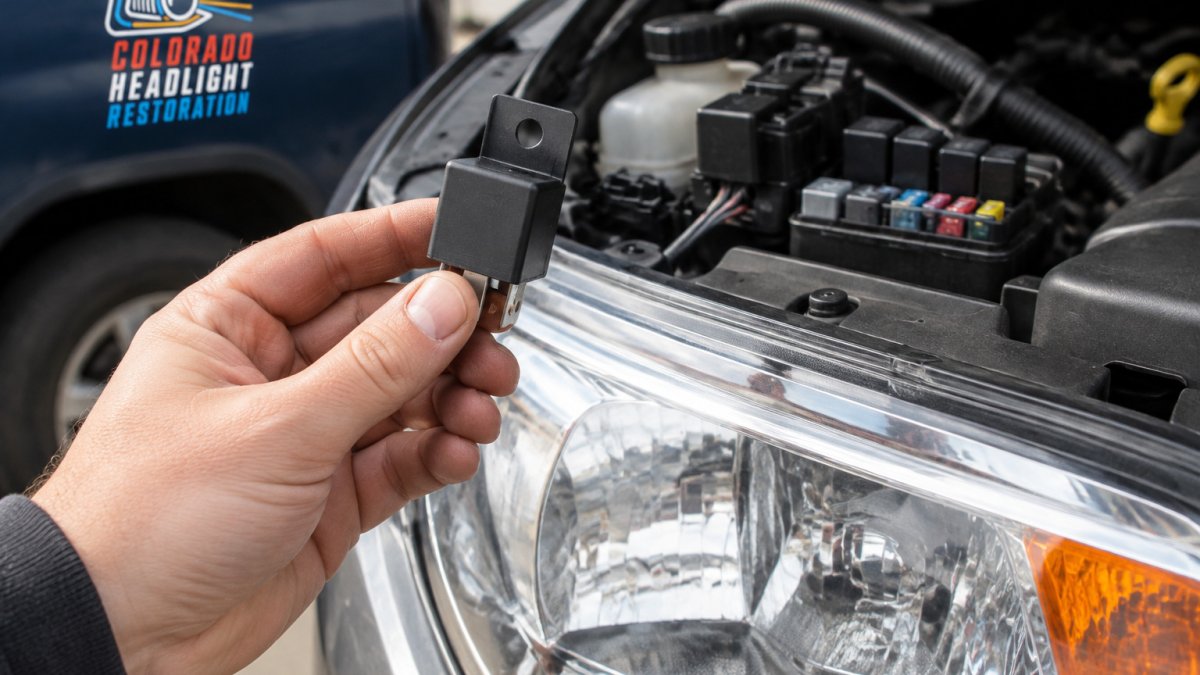
A headlight relay is a small electrical switch that sends battery power to your headlights when you turn them on.
Your headlights are your first line of defense at night. A failed relay can leave you with no low beams on a dark highway. That is a safety problem, not just an annoyance.
Below, we explain the seven symptoms of headlight relay problems, walk you through a safe multimeter test, and show you how to fix a bad relay without guessing. We also cover what to check when the relay turns out fine, because a bad relay is not always the culprit.
7 Symptoms of a Failing Headlight Relay
Watch for these seven signs, from no power at all to strange noises under the dash:
- Headlights that will not turn on
- Headlights that will not turn off
- Flickering or intermittent lights
- High beams or low beams stuck on
- A clicking noise from the relay or fuse box
- One headlight working while the other stays dark
- Pop-up headlight doors that stop opening or closing
A common mistake is replacing bulbs first. Test the relay before you spend money on parts you may not need.
Headlights That Won't Turn On or Off
Complete headlight failure is the clearest sign of a dead relay. You flip the switch, the dash lights come on, but the road stays dark.
That stuck-on problem drains your battery fast. If your headlights will not turn off, pull the relay fuse or disconnect the battery before it dies overnight.
Flickering, Clicking, and Stuck Beams
Intermittent operation points to a relay with corroded terminals or a loose connection. The lights may flicker over bumps or cut out for a second, then come back.
Stuck high beams are just as dangerous. You blind oncoming drivers and cannot switch to low beams. If beam switching fails, the relay or the headlight switch is usually to blame.
How to Check a Headlight Relay With a Multimeter
A multimeter turns relay diagnosis from guesswork into a yes-or-no answer.
Before you start, gather three things: your owner's manual (for the fuse-box diagram), a digital multimeter, and a small flathead screwdriver or plastic trim tool for releasing the relay. Work with the ignition off and the key in your pocket.
Step 1: Locate the correct relay
Open the under-hood fuse box or the interior fuse panel and compare what you see against the diagram in your owner's manual. Relay layouts vary by make, model, year, and even trim level, so do not assume the label on the box matches the diagram. The headlight relay is often marked "HDLP," "HEAD," or "H/L," but abbreviations differ.
Step 2: Identify the pins
The pin numbers are printed on the relay case or molded into the plastic base. A common four- or five-pin automotive relay uses two coil pins (often 85 and 86) and two or three contact pins (30, 87, and sometimes 87a). The diagram on the relay tells you which is which for that part.
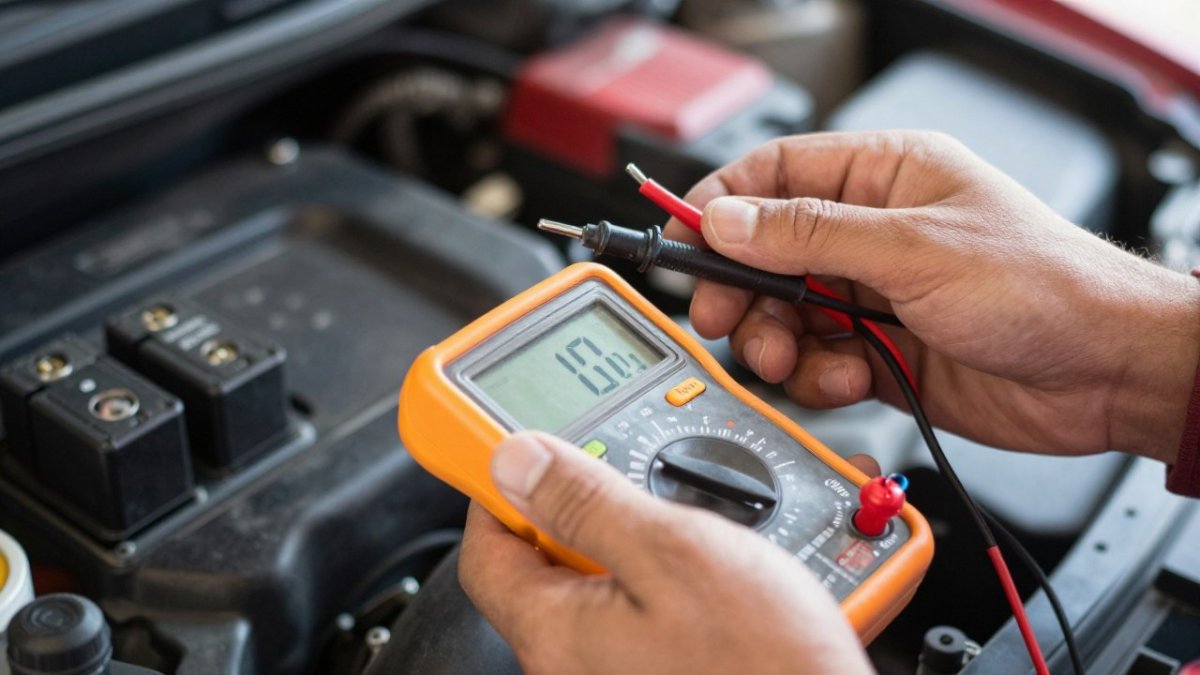
Step 3: Test the coil
Set the multimeter to resistance (ohms). Touch one probe to each coil pin. A healthy coil reads a steady resistance; the exact spec is in the service information for your relay. A reading of zero means a shorted coil; infinite means an open coil. Either way, the relay is bad.
Step 4: Test the contacts
With the relay out, the contact pins should read open (infinite resistance) in the de-energized state. To test them under power, you need the relay energized. One safe method is to have a helper turn the headlight switch on while you measure voltage at the socket, not the relay.
Step 5: Inspect the socket and pins
Look inside the socket for corrosion, melted plastic, or pushed-back terminals. A relay can test good on the bench and still fail in a corroded socket. Watch out: forcing a relay into a socket with bent or recessed terminals can spread the contacts and create a worse connection than the one you started with.
Step 6: Decide what the results mean
- Coil open or shorted: replace the relay.
- Contacts stuck closed: replace the relay; this is the classic cause of headlights that will not turn off.
- Relay tests good but no voltage at the socket: diagnose the fuse, switch, ground, and wiring before buying a relay.
If you plan to swap bulbs or the relay yourself, our guide on 7 DIY headlight replacement tools and safety tips covers the gear and habits that keep the job clean and safe.
Finding the Headlight Relay Location on Your Vehicle
The headlight relay location varies by make and model, but it almost always lives in one of two places: the fuse box under the hood or the fuse panel inside the cabin. Check your owner's manual first. It lists every relay and fuse with a diagram.
Common spots include:
- The under-hood fuse box near the battery
- The interior fuse panel below the dash
- A separate relay box near the radiator support
Some vehicles use a dedicated relay for each side. Others share one relay for both low beams. Knowing which layout you have saves time. A wiring diagram for your model shows the exact pin numbers and wire colors, so grab one before you start testing.
The Headlight Relay Fuse: A Cheap Check Before You Replace Anything
The headlight relay fuse is the cheapest thing to check first. A blown fuse costs almost nothing to replace and takes one minute to swap.
Look for a fuse that is blackened, broken, or has a melted plastic body. A discolored relay or fuse points to heat buildup from a loose connection or a failing circuit.
How to Fix a Faulty Headlight Relay
Fixing a faulty headlight relay is a straightforward swap. Pull the old relay, match the part number, and push the new one into the same slot.
Follow these steps:
- Buy the exact replacement relay for your model
- Disconnect the battery for safety
- Pull the old relay and check the socket for corrosion
If the socket itself is burned or the wiring is damaged, stop and get a professional to look at it. Bad wiring can start a fire.
When Relay Problems Aren't the Real Culprit
A relay is one link in a chain that runs from the battery through fuses, the headlight switch, wiring, grounds, and the bulbs themselves. A failure anywhere in that chain can mimic a relay symptom. The fastest way to avoid buying parts you do not need is to match the symptom pattern to the most likely cause before you test anything.
Blown bulbs
A burned bulb usually takes out one side, not both. If one headlight is dark and the other works, check the bulb and its socket first. Bulbs also fail from vibration, moisture intrusion, or a bad seal, and a bulb that looks intact can still have a broken filament.
Blown fuses
A fuse protects the circuit, and a blown fuse is the cheapest thing to rule out. Pull the fuse and hold it up to light: a broken element or blackened body means replace it with the same amperage rating. Never install a higher-rated fuse to "fix" a blowing fuse; that lets excess current reach the wiring and can start a fire.
Bad grounds
Headlights depend on a solid ground to complete the circuit. A corroded or loose ground strap can cause dim lights, flickering, or lights that work on one side only. A voltage-drop test between the bulb ground and the battery negative terminal reveals excessive resistance that a simple continuity check misses.
Faulty headlight switch
The switch sends the trigger signal to the relay. A worn switch can fail to send power, send it intermittently, or fail to switch between high and low beams. If the relay tests good but never receives a trigger signal, the switch or its connector is the next suspect.
Damaged wiring and connectors
Rodent damage, chafed insulation, and heat-hardened connectors all cause intermittent or dead circuits. Look for green corrosion, melted insulation, or pins that push back when you probe them. Wiring faults are the most common reason a new relay does not fix the problem.
Charging-system problems
A weak battery or failing alternator can make headlights dim at idle and brighten with engine speed. If the lights improve when you rev the engine, test the battery and charging system before touching the relay.
Quick symptom-to-cause map
- Both lights dead: relay, fuse, switch, or main ground
- One light dead: bulb, socket, or that side's ground
- Dim or uneven output: voltage drop, corroded ground, or charging system
If the relay checks out and your brightness is still uneven, our article on how to find the causes of uneven headlight brightness walks through the remaining suspects. Our guide on how headlight lens condition affects night driving visibility explains how much clarity you lose and what it costs you in reaction time.
Match the symptom pattern to the most likely cause before you buy any parts.
| Symptom | Likely cause |
|---|---|
| Both lights dead | Relay, fuse, switch, or main ground |
| One light dead | Bulb, socket, or that side's ground |
| Dim or uneven output | Voltage drop, corroded ground, or charging system |
| Lights stay on | Stuck relay contacts or a shorted switch |
| Rapid clicking | Low coil voltage from a loose ground or failing switch |
| Lights work but road looks dim | Cloudy lens, not an electrical fault |
Book a Headlight Inspection Before Your Next Night Drive
Electrical fixes restore function, but they cannot fix a yellowed, hazy lens. If your headlights work and the road still looks dark, the lens may be the problem.
Our mobile service includes a ceramic UV sealant designed to withstand high-altitude sun for up to three years. We back the work with a one-year free re-restoration guarantee. It costs a fraction of full headlight assembly replacement.
Want to know what a visit involves? Read what to expect from a headlight restoration service, or browse the Colorado headlight resource center for local service pages and vehicle-specific answers.
Your headlights should light the road, not leave you guessing. If a relay test or a cloudy lens has you stuck, one call gets you a clear answer.
Frequently Asked Questions
How do I know if my headlight relay is going bad?
Watch for headlights that won't turn on, won't turn off, flicker, or fail to switch between high and low beams. A clicking or rattling noise from the fuse box is another clue. You can confirm a bad headlight relay by swapping it with an identical relay nearby, or by testing its terminals with a multimeter for the expected voltage and continuity.
Can a bad headlight relay cause only one headlight to work?
Yes. Many vehicles use separate relays for the left and right headlight circuits, so a failed relay can knock out one side while the other keeps working. Before replacing anything, check the bulb, the socket, and the ground connection on the dead side. If those are fine, test the relay and the wiring that feeds that specific headlight.
How much does it cost to replace a headlight relay?
A replacement relay is typically one of the less expensive parts on the car. Labor is minimal because the relay simply pulls out of the fuse box and pushes back in. Dealer pricing runs higher than an independent shop, so ask for a quote. If the relay tests fine but the lights still fail, the problem may be the switch or wiring, which costs more to diagnose.
Can a blown fuse cause both headlights to stop working?
Yes. If a single fuse feeds both headlights, a blown fuse will kill them together. Check the headlight relay fuse in the fuse box first, since it costs almost nothing to replace. If a new fuse blows right away, stop and find the short circuit before driving. A repeated blown fuse points to damaged wiring or a failing component, not just a tired fuse.

Learn more about our headlight restoration in Denver, or see headlight restoration in Longmont.
Cloudy headlights? Get your price in 30 seconds.
Mobile service across the Denver metro. Most vehicles finished in 30–60 minutes, right in your driveway.