
Table of Contents
- Why Professional Headlight Restoration Matters for Safety
- Signs Your Headlights Need Professional Restoration
- Mobile Headlight Restoration Near Me: Convenience Without Compromise
- How Long Does Headlight Restoration Take and What to Expect
- Benefits of Ceramic UV Sealant for Headlights
- Restoration vs. Full Headlight Replacement: Which Makes Sense
- Maintenance Tips After Headlight Restoration
- Frequently Asked Questions
Last Updated: September 22, 2026
Why Professional Headlight Restoration Matters for Safety
Cloudy, yellowed, and oxidized headlights reduce your nighttime visibility by up to 80 percent. This isn't merely an aesthetic problem, it directly impacts your ability to see the road and be seen by other drivers, with measurable safety consequences.
The Safety Data Behind Headlight Clarity
According to the National Highway Traffic Safety Administration (NHTSA), visibility-related crashes account for approximately 9,000 fatal and 130,000 injury crashes annually on U.S. roads. Many of these incidents occur during low-light conditions where headlight performance is critical. Degraded headlights, whether yellowed, cloudy, or dim, reduce the distance at which a driver can see obstacles, pedestrians, and oncoming traffic. A driver with severely oxidized headlights may only see 150 feet ahead at 55 mph, compared to 350+ feet with clear, properly functioning headlights. That lost visibility translates to a reaction-time deficit that can mean the difference between avoiding a collision and experiencing a crash.
The Federal Motor Vehicle Safety Standard (FMVSS) 108 establishes minimum headlight brightness and beam pattern requirements. Oxidized headlights often fail to meet these standards, which is why many states include headlight clarity in vehicle inspection protocols. If your headlights are too dim or cloudy, your vehicle may not pass inspection, and more importantly, you're driving with compromised safety.
Why Restoration Solves the Problem
When UV rays and environmental exposure degrade your headlight lens, the polycarbonate coating breaks down. This causes the hazy appearance that makes driving at night feel like looking through fog. Professional restoration removes the oxidized layer and applies a durable ceramic UV sealant to prevent the problem from returning.
A headlight restoration service restores your headlights to near-original brightness and beam clarity. This improvement directly translates to better visibility, reduced eye strain during night driving, and a measurable safety advantage, all without the expense of full headlight replacement.
Signs Your Headlights Need Professional Restoration
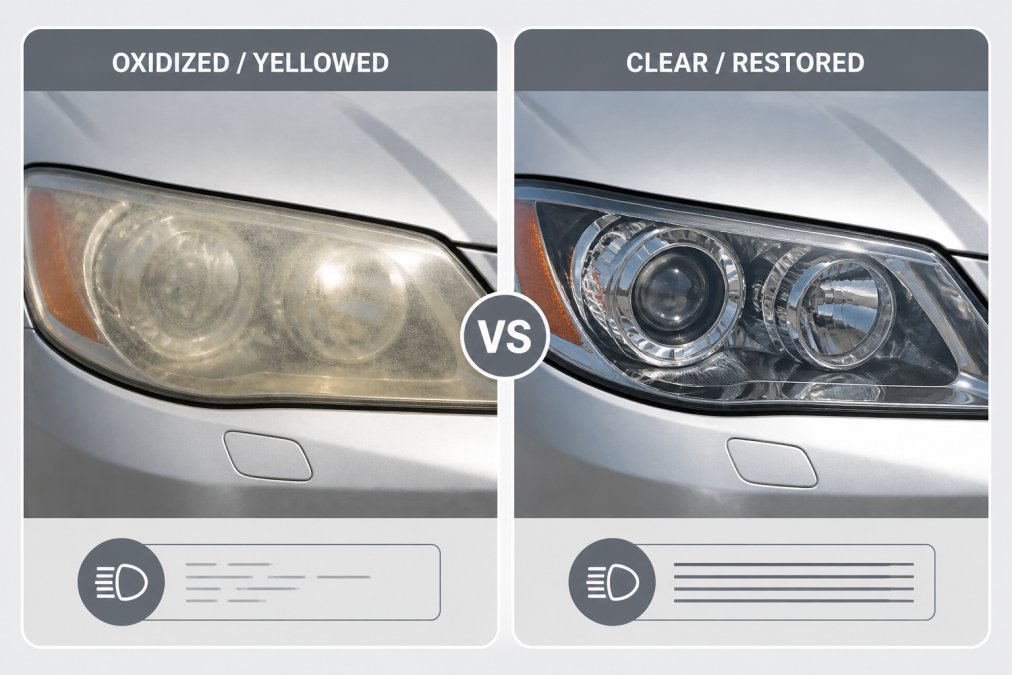
Your headlights need restoration when you notice reduced brightness, yellowing, cloudiness, or a hazy film covering the lens. These are the most common indicators that oxidation has begun to degrade your headlight clarity.
Look for these specific warning signs:
- Visible cloudiness or haze on the lens surface that worsens over time
- Yellowing or browning of the clear-coat layer
- Reduced light output at night, making the road ahead appear dimmer
- Uneven clarity, with some areas more cloudy than others
- Difficulty passing vehicle inspection due to headlight brightness requirements
The longer you wait, the more severe the oxidation becomes. Early-stage yellowing responds quickly to professional restoration. Advanced oxidation that has penetrated deep into the polycarbonate takes longer to reverse and may require more aggressive sanding and polishing.
A professional headlight restoration service can assess the damage and determine whether restoration makes sense for your vehicle.
Mobile Headlight Restoration Near Me: Convenience Without Compromise
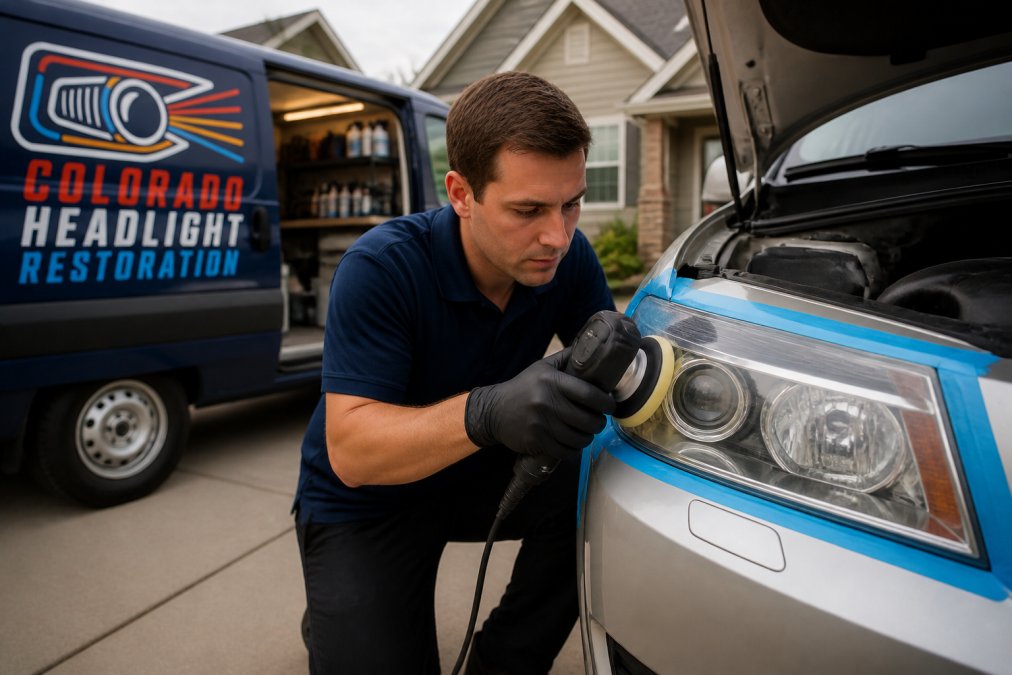
The biggest advantage of mobile headlight restoration is that the service comes to you. You don't need to drive to a shop, wait for hours, or arrange alternative transportation. A mobile technician arrives at your home or office, completes the entire restoration on-site, and you're done before lunch.
How Long Does Headlight Restoration Take and What to Expect
A professional headlight restoration typically takes 30-60 minutes from start to finish. The exact duration depends on how severe the oxidation is, the size and shape of your headlight lenses, and whether both headlights need restoration or just one.
Here's what the process involves:
- Assessment - The technician examines your headlights to determine the oxidation level and choose the appropriate restoration approach
- Sanding and polishing - The oxidized layer is carefully removed using professional-grade abrasive materials and polishing compounds
- Refinishing - The lens is buffed to restore clarity and light transmission
- Ceramic UV sealant application - A durable protective coating is applied to shield the lens from future UV damage
- Final inspection - The technician verifies that both headlights match in brightness and clarity
Benefits of Ceramic UV Sealant for Headlights
The ceramic UV sealant is what separates professional restoration from temporary fixes. This protective coating bonds to the polycarbonate lens and creates a barrier against ultraviolet rays, oxidation, and environmental contaminants.
Benefits of ceramic UV sealant include:
- Extended protection - Lasts up to three years in high-altitude Colorado conditions with intense sun exposure
- UV blocking - Prevents the clear-coat from breaking down and yellowing again
- Water resistance - Repels moisture and road spray that accelerates oxidation
- Enhanced clarity - Maintains the restored lens brightness longer than unsealed restoration
- Cost savings - Delays the need for another restoration or full headlight replacement
Restoration vs. Full Headlight Replacement: Which Makes Sense
The choice between restoration and replacement depends on the headlight condition, your vehicle's age, and your budget. Understanding when each option makes sense helps you make the right decision and avoid unnecessary expense.
When Restoration Is the Right Choice
Restoration is the appropriate solution when:
- Your headlights are yellowed, cloudy, or hazy but structurally intact. If the lens has no cracks and the housing is not leaking, restoration will restore clarity and light output.
- The damage is surface-level oxidation. Oxidation that has not penetrated deep into the polycarbonate responds well to professional sanding, polishing, and sealant application.
- Your vehicle is worth maintaining long-term. If you plan to keep your car for several more years, restoration delivers a strong return on investment.
- You want to avoid the cost and downtime of replacement. A full headlight assembly replacement typically costs more, plus labor and potential alignment adjustments. Restoration costs a fraction of that.
- You want to pass vehicle inspection. Many states require headlights to meet brightness and clarity standards. Restoration often brings faded headlights back into compliance.
When Full Replacement Is Necessary
Replacement is the only viable option when:
- The lens has deep cracks, severe pitting, or structural damage. Once the polycarbonate housing is compromised, restoration cannot seal or repair the damage. Water will continue to enter the assembly, and the lens will fail again quickly.
- The headlight housing is leaking or the internal reflector is corroded. Moisture inside the headlight assembly indicates a seal failure. Restoration addresses only the external lens; it cannot fix internal corrosion or reflector damage.
- The headlight has failed electrically or the bulb socket is damaged. If the problem is not oxidation but rather a non-functional bulb, ballast, or electrical connection, replacement of the entire assembly may be necessary.
- Your vehicle is newer and you want factory-new performance and warranty coverage. New headlight assemblies come with manufacturer warranties and OEM beam patterns that restoration cannot match.
The Financial Math: Restoration vs. Replacement Over Time
How to Know If Your Headlights Can Be Restored
Maintenance Tips After Headlight Restoration
After your headlight restoration, simple maintenance extends the life of the ceramic UV sealant and keeps your headlights clear.
Follow these maintenance practices:
- Wash your headlights regularly - Use soft cloths and gentle soap when washing your vehicle; avoid abrasive scrubbing that can damage the sealant
- Park in shade when possible - Reduce direct sun exposure, especially during peak UV hours, to slow sealant degradation
- Apply headlight protectant - Every 6-12 months, apply a UV protectant product designed for headlights to reinforce the sealant
- Avoid harsh chemicals - Don't use strong degreasers or abrasive cleaners on your headlights
- Monitor for early yellowing - If you notice slight haziness returning, contact your service provider about touch-up options
Frequently Asked Questions
How long does professional headlight restoration last?
Professional headlight restoration with ceramic UV sealant typically lasts 2-3 years, depending on climate and sun exposure. The ceramic sealant is designed to withstand UV rays and weather damage. Colorado's high altitude and intense sun can accelerate wear, but quality professional-grade sealants outlast DIY restoration kits significantly. Most providers, including Colorado Headlight Restoration, offer a one-year re-restoration guarantee to ensure your investment holds up.
Is headlight restoration worth it compared to buying new assemblies?
Restoration is typically worth it when headlights are oxidized or yellowed but structurally sound. New OEM headlight assemblies can cost significantly more, while professional restoration costs a fraction of that. Restoration restores clarity and improves nighttime visibility without the expense of replacement. However, if your headlight housing is cracked or the internal reflector is damaged, replacement may be necessary. A professional inspection helps determine which option makes sense for your vehicle.
What makes professional headlight restoration better than DIY kits?
Professional restoration uses industrial-grade abrasives, polishing compounds, and professional-grade ceramic UV sealants that DIY kits cannot match. Professionals have the equipment and experience to achieve OEM clarity consistently. DIY kits often produce temporary results that fade within weeks because they lack durable sealant protection. Professional services also come with guarantees, whereas DIY results are your responsibility. The ceramic UV sealant applied by professionals is engineered to last years in harsh climates.
Will headlight restoration work on older vehicles?
Headlight restoration works on most vehicles regardless of age, as long as the headlight lens and housing are intact. Older vehicles often benefit most from restoration because their headlights have accumulated years of UV damage and oxidation. The restoration process removes this oxidation and restores clarity to the polycarbonate lens. However, if the lens is cracked, severely pitted, or the internal reflector is damaged, the technician may recommend replacement instead. A professional evaluation determines whether your specific headlights are suitable for restoration.
Cloudy headlights reduce your safety and hurt your vehicle's appearance. Professional headlight restoration from Colorado Headlight Restoration restores OEM clarity in 30-60 minutes with a ceramic UV sealant that protects for up to three years. You'll improve nighttime visibility, pass vehicle inspections, and save hundreds of dollars compared to full headlight replacement. Get started with Colorado Headlight Restoration and schedule your mobile restoration appointment today.
Cloudy headlights? Get your price in 30 seconds.
Mobile service across the Denver metro. Most vehicles finished in 30–60 minutes, right in your driveway.