Table of Contents
- Yellowing and Fading Headlight Lenses
- Cloudy, Hazy, or Dull Headlight Appearance
- Reduced Brightness and Nighttime Visibility Issues
- How to Restore Cloudy Headlights Professionally
- Professional Headlight Restoration vs. DIY Kits
- Headlight Restoration vs. Replacement: Which Option Makes Sense
- Understanding Headlight Restoration Cost and Durability
- When Restoration Won't Work and Replacement Is Necessary
- Frequently Asked Questions
Last Updated: October 5, 2026
Yellowing and Fading Headlight Lenses
Headlight restoration becomes necessary when UV exposure and oxidation turn your lenses yellowed or faded, especially in areas with intense sun.
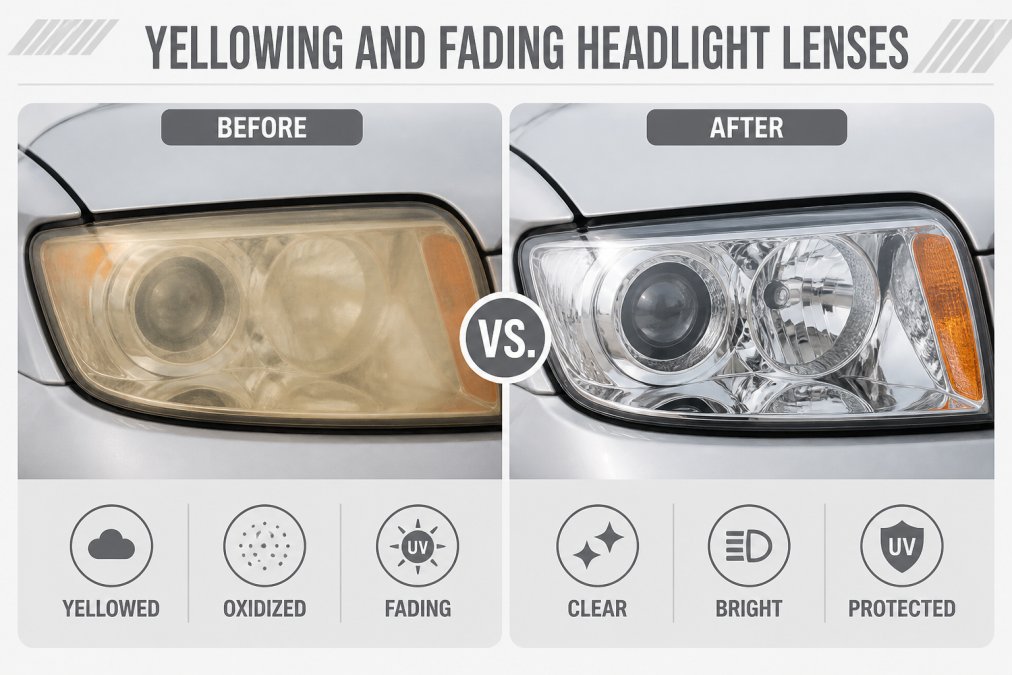
UV rays break down the lens's protective coating, and the plastic underneath oxidizes and turns yellow or brown.
Yellowing typically starts at the edges and spreads inward, leaving a cloudy, dull appearance, one of the clearest signs that headlight restoration would help.
Cloudy, Hazy, or Dull Headlight Appearance
A cloudy or hazy headlight is one of the most common reasons vehicle owners seek headlight restoration: milky or foggy lenses have surface oxidation that reduces how much light reaches the road.
The dull look comes from microscopic pitting and oxidation on the lens surface, not dirt you can wash away. Professional headlight restoration removes this layer and seals the lens against future oxidation.
Many drivers describe their headlights as "cloudy" when they first notice the problem.
How to Tell If Damage Is External or Internal
Distinguishing external oxidation from internal damage determines whether restoration will work. External damage sits on the lens surface; internal damage means moisture got inside the sealed assembly.
External oxidation signs:
- Yellowing or clouding visible on the outside surface
- Damage you can feel with your fingernail (rough texture)
- Haziness that affects the entire lens evenly
- Problem started gradually over months or years
Internal damage signs:
- Moisture droplets visible inside the lens
- Condensation that fogs up and clears with temperature changes
- Damage concentrated in one spot or corner
- Problem appeared suddenly after heavy rain or car wash
If you see moisture inside the headlight assembly, restoration won't help. You'll need a replacement headlight. But if the damage is external yellowing or clouding, professional headlight restoration can restore clarity.
Reduced Brightness and Nighttime Visibility Issues
Reduced brightness is dangerous at night, in rain, or in fog: you can't see hazards as far ahead, and other drivers have a harder time seeing you.
If you're squinting more during night drives, your headlights probably need restoration.
Nighttime visibility issues are often the wake-up call that makes drivers act. Many realize they've been driving with compromised visibility for months.
How to Restore Cloudy Headlights Professionally
Professional headlight restoration removes oxidation and seals the lens in 30 to 60 minutes per vehicle, depending on damage severity. At Colorado Headlight Restoration, we handle this at your home or office.
The professional restoration process includes:
- Assessment of damage (external vs. internal)
- Cleaning and decontamination of the lens surface
- Progressive sanding to remove oxidized layers
- Polishing to restore clarity
- Application of ceramic UV sealant
- Final quality check and testing
The ceramic UV sealant is the critical step that makes professional restoration last, shielding the lens from future UV damage and oxidation.
Professional restoration returns your headlights to OEM clarity, so they look and perform like new, transmitting light without the yellow or hazy appearance.
Professional Headlight Restoration vs. DIY Kits
DIY headlight restoration kits are sold at most auto parts stores and online retailers, and they can work, for a while. Knowing where they fall short helps you decide whether to spend a Saturday in the driveway or hire a professional.
What a typical DIY kit contains:
- Several sheets of wet/dry sandpaper in progressively finer grits (commonly 400, 800, 1500, and 2000 or 3000)
- A small bottle of polishing compound
- A foam or microfiber applicator pad
- A wipe-on sealant, often a wipe of UV-blocking clear coat or a polymer "protectant"
The DIY process, step by step:
- Wash and degrease the lens so grit doesn't grind contaminants into the plastic.
- Mask the paint around the headlight with painter's tape.
- Wet-sand with the coarsest grit first, keeping the paper and lens wet, until the yellow layer is gone.
- Step up through each finer grit, sanding in a different direction each time so you can see when the previous scratches are removed.
- Polish with the compound until the lens is clear.
- Apply the sealant and let it cure.
The catch is step 6. Most kit sealants are thin polymer coatings that break down under UV within weeks to months.
Where DIY makes sense:
- Light haze or early yellowing on a single lens
- A vehicle you plan to sell or trade within a few months
- You already own a polisher and enjoy the work
- You're willing to reapply sealant every few months
Where professional restoration wins:
- Moderate to heavy oxidation that needs aggressive sanding
- Both headlights on a daily driver you plan to keep
- Vehicles with complex or curved lens shapes where hand-sanding leaves swirl marks
- Anyone who wants a multi-year result instead of a multi-month one
The real difference isn't the sanding, it's the sealant.
Headlight Restoration vs. Replacement: Which Option Makes Sense
When restoration makes sense:
- Damage is external yellowing or oxidation only
- No internal moisture or condensation present
- You want to improve appearance and visibility quickly
- Budget is a concern
- Vehicle has good resale potential
When replacement is necessary:
- Internal damage or moisture inside the assembly
- Lens is cracked or physically broken
- Bulb or wiring inside is damaged
- Restoration won't work (internal issues)
For most vehicles with cloudy or yellowed headlights, restoration is the smart choice, you improve nighttime visibility and appearance without the expense of full replacement, with results comparable to new headlights.
Restoration also makes sense when preparing a vehicle for sale: cloudy headlights make it look older and less maintained, while clear, restored lenses improve curb appeal and perceived condition.
Understanding Headlight Restoration Cost and Durability
Two questions come up most once a driver decides to restore their headlights: what will it cost, and how long will it last? The answers depend on a handful of variables, and understanding them helps you compare quotes and set realistic expectations.
What drives the cost
Professional headlight restoration is priced per vehicle, not per hour, and most shops quote a range based on:
- Damage severity. Light haze needs a polish and seal; heavy yellowing needs full wet-sanding through multiple grits. The labor difference is significant.
- Lens size and shape. Large truck and SUV lenses take longer than compact car lenses, and complex curves are harder to sand evenly.
- Sealant tier. A basic polymer sealant is cheaper than a ceramic or UV-cured clear coat, and the price difference reflects the durability difference.
- Mobility. Mobile services that come to your home or office typically build travel into the price.
- Number of headlights. Almost always quoted as a pair, since restoring one and not the other looks worse than leaving both alone.
For a specific quote on your vehicle, check the Colorado Headlight Restoration pricing page, pricing varies too much by vehicle and condition to publish a single number that would be accurate for everyone.
What actually determines how long restoration lasts
"Up to three years" is a ceiling, not a guarantee. Several factors push you toward or away from that ceiling:
- Sealant chemistry. A true ceramic or UV-cured clear coat cross-links into a hard film that resists UV breakdown. A wipe-on polymer protectant sits on the surface and washes or bakes off. The chemistry, not the brand name, is what matters.
- UV load. Vehicles parked outdoors in intense sun, high-altitude regions, the Southwest, coastal areas with reflected light, age faster than garaged vehicles in milder climates.
- Washing habits. Automatic brush car washes and harsh degreasers strip sealants. Hand washing with a pH-neutral soap preserves them.
- Wax and top-coat maintenance. A coat of UV-protectant wax or sealant every few months extends the life of the base coating.
- Physical damage. Rock chips and road debris break the seal and give oxidation a starting point.
A realistic maintenance routine after restoration:
- Wash with pH-neutral soap; skip the brush tunnel.
- Apply a UV-protectant wax or spray sealant every 2-3 months.
- Inspect the lens edges, that's where oxidation restarts first.
- If you see the first hint of haze returning, address it before it spreads.
The re-restoration guarantee
Colorado Headlight Restoration includes a one-year free re-restoration guarantee. If your headlights start to haze within that period, we restore them again at no charge. That guarantee exists because a properly sealed lens shouldn't fail in the first year, if it does, the coating or the prep was the problem, not the driver.
Restoration vs. replacement, in cost terms
New OEM headlight assemblies commonly cost hundreds of dollars per unit, and aftermarket units vary widely in quality and beam pattern accuracy. Add installation labor if the bumper has to come off, and the total climbs quickly. Restoration typically costs a fraction of that per vehicle, which is why it's the default recommendation whenever the damage is external and the housing is intact. The section above on when restoration won't work covers cases where replacement is the only real option.
When Restoration Won't Work and Replacement Is Necessary
Not every cloudy headlight can be restored.
Restoration won't work when:
- The lens is cracked or physically broken
- Internal moisture or condensation is visible inside the assembly
- The bulb socket or wiring is damaged
- The lens has deep gouges or severe physical damage
- The problem is internal fogging that appears and disappears with temperature changes
Signs you need replacement instead of restoration:
- Moisture droplets inside the headlight that won't dry out
- Water pooling inside the lens after rain
- Condensation that fogs and clears repeatedly
- Visible damage to the lens structure itself
- Bulb or electrical components showing damage
A professional inspection determines whether your headlights are candidates for restoration or need replacement.
If your headlights have internal moisture or physical damage, restoration isn't the answer, attempting it wastes money and doesn't solve the problem.
Many vehicle owners aren't sure whether their headlights can be restored.
If your headlights look cloudy, yellowed, or hazy, professional restoration can restore them to OEM clarity and improve your nighttime visibility.
Frequently Asked Questions
How do I know if my headlights need restoration?
Common signs include yellowing or fading plastic lenses, a cloudy or hazy appearance, reduced light output at night, and visible oxidation or spots on the surface. If you notice your headlights look dull compared to when the vehicle was new, or if nighttime visibility has noticeably decreased, restoration is likely needed. Check both headlights, one may be more affected than the other depending on sun exposure and driving direction.
Can I tell if my headlights are cloudy on the outside or damaged inside?
Exterior oxidation and clouding typically affect the outer plastic lens surface and respond well to professional restoration. Internal condensation or moisture appears as droplets or fog inside the sealed headlight assembly and requires replacement, not restoration. To distinguish them, inspect the lens closely in bright light, external damage shows as a dull, hazy coating; internal moisture looks wet or creates a visible layer inside the sealed unit. Professional restoration addresses external oxidation but cannot fix internal seal failure.
How long does professional headlight restoration last?
Professional restoration with a ceramic UV sealant typically lasts up to three years, depending on sun exposure and climate conditions. High-altitude areas with intense UV radiation may see recurrence sooner. Many professional services, including Colorado Headlight Restoration, offer a one-year free re-restoration guarantee. This durability significantly outlasts DIY kits, which often fade within weeks or a few months, making professional restoration a cost-effective choice for long-term clarity.
Should I restore my headlights or replace them entirely?
Restoration is the right choice if your headlights are structurally sound and the clouding is caused by external oxidation or UV damage. Replacement becomes necessary if the lens is cracked, the internal seal is broken (causing moisture), or the headlight assembly is damaged beyond surface restoration. Restoration costs a fraction of full assembly replacement and improves nighttime visibility significantly. However, if damage is severe or internal, replacement is the only permanent solution and ensures full OEM performance.
Learn more about our headlight restoration in Denver, or see headlight restoration in Longmont.
Cloudy headlights? Get your price in 30 seconds.
Mobile service across the Denver metro. Most vehicles finished in 30–60 minutes, right in your driveway.