
Table of Contents
- Why Busy Professionals Choose Mobile Headlight Restoration
- How Long Does Headlight Restoration Take?
- Mobile Headlight Restoration at Work: What the Visit Looks Like
- Headlight Restoration Cost vs Replacement Cost
- Headlight Restoration vs Replacement: Which Makes Sense?
- How to Choose a Mobile Headlight Restoration Provider
- Frequently Asked Questions
Last Updated: October 15, 2026
Why Busy Professionals Choose Mobile Headlight Restoration
Mobile headlight restoration is a professional service that brings the full lens restoration process to your home or office instead of requiring you to leave your car at a shop. For busy professionals, that convenience matters: our team at Colorado Headlight Restoration restores cloudy, yellowed, and oxidized headlights to OEM clarity on-site in 30 to 60 minutes, with no drop-off and no waiting room.
Cloudy lenses are more than a cosmetic problem. Oxidation and UV exposure gradually break down the protective clear coat on plastic headlight housings, leaving a yellow film that scatters light before it reaches the road. The American Automobile Association's guidance on vehicle lighting and visibility notes that dim or hazy headlights reduce how far you can see at night, which shortens your reaction time to pedestrians, cyclists, and debris.
That's the part most drivers miss: faded lenses don't just look bad, they quietly cut your nighttime visibility. And for commuters along the Front Range, where sun exposure is intense, that decline happens faster than most people expect.
The Hidden Cost of Cloudy Headlights
The real cost of cloudy headlights shows up in three places: safety, resale value, and money. Dim light output means less time to react at highway speed. A hazy, yellowed front end signals neglect to any buyer or trade-in appraiser. And the "obvious" fix, replacing the entire headlight assembly, is often the most expensive option on the table.
Many drivers assume replacement is the only cure. It isn't. In most cases, the housing and internal components are fine; it's the outer lens surface that has oxidized. Restoring that surface addresses the actual problem at a fraction of the cost.
How Mobile Service Fits a Packed Schedule
A traditional shop visit means driving there, waiting, and losing half a day. Mobile service removes every one of those steps. You park as usual, we arrive with everything needed, and you keep working while your headlights are restored.
- No drop-off or rental car
- No waiting room
- No rearranging your calendar around a shop's hours
For professionals who bill by the hour, the time saved is often worth as much as the service itself.
How Long Does Headlight Restoration Take?
Headlight restoration typically takes 30 to 60 minutes per vehicle when performed by a professional mobile technician. The exact time depends on how far the oxidation has progressed and whether both lenses need equal work.
Here's what drives the range:
- Light oxidation: closer to 30 minutes
- Moderate yellowing and haze: 40 to 50 minutes
- Heavy oxidation or surface damage: the full 60 minutes
The process itself follows a fixed sequence: cleaning, hand sanding through progressively finer abrasives, polishing, and sealing. Skipping the sealant is the most common shortcut, and it's why DIY results fade.
What Happens If Your Headlights Need More Work?
If a technician arrives and finds deeper lens damage than expected, the honest answer is that the timeline may extend. A reputable provider will tell you before starting, not after. Ask upfront how additional work is priced so there are no surprises. At Colorado Headlight Restoration, we assess the lenses on arrival and confirm the scope before any work begins.
Mobile Headlight Restoration at Work: What the Visit Looks Like
A mobile visit is straightforward: the technician arrives at your parking spot, sets up a small work area, and restores both headlights while you stay at your desk. No bay, no lift, no disruption to your day.
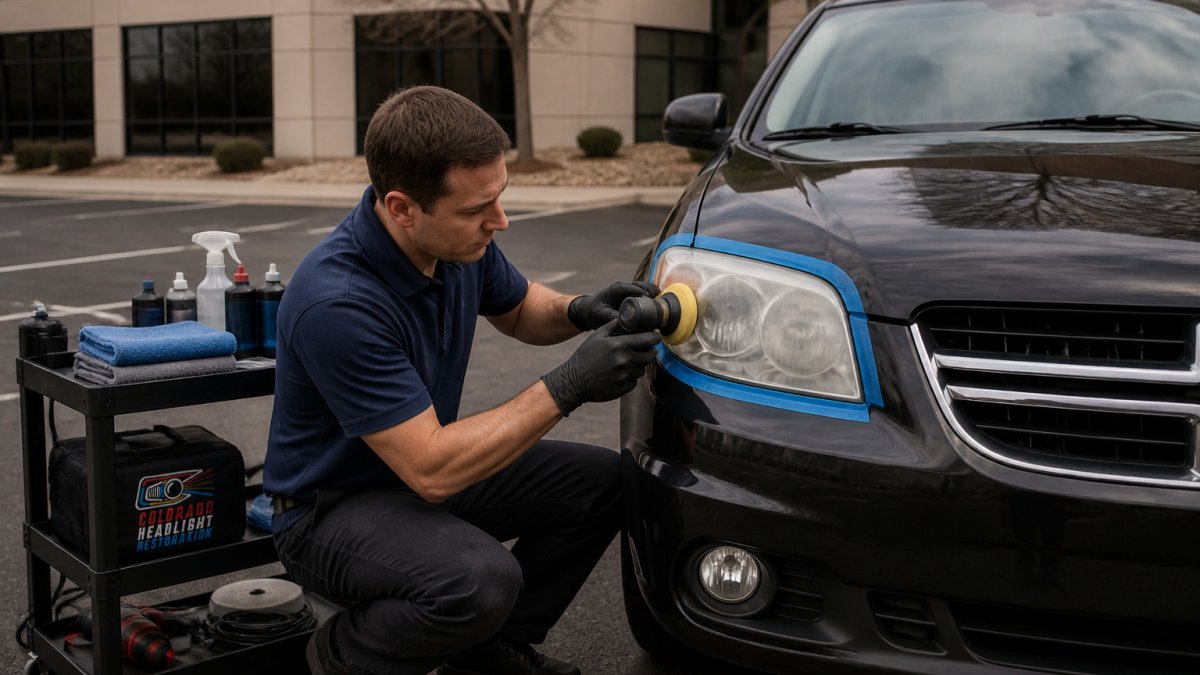
The steps look like this:
- Inspection. The technician checks lens condition and confirms the plan.
- Masking. Trim and paint around the headlight are taped off.
- Cleaning. Dirt, road film, and surface contaminants are removed.
- Sanding. Hand sanding with progressively finer abrasives strips the oxidized layer.
- Polishing. The lens is polished back to optical clarity.
- Sealing. A ceramic UV sealant is applied to protect the restored surface.
- Final check. You review the result before the technician leaves.
The whole visit stays inside the 30-to-60-minute window, and you never leave your vehicle.
Headlight Restoration Cost vs Replacement Cost
Restoration almost always costs far less than replacement, but the size of that gap depends on your vehicle. A full headlight assembly replacement means buying new housings, and on many modern vehicles those units are expensive, often several hundred dollars per side once parts and labor are included, and more on vehicles with LED or projector assemblies. Restoration works on the lenses you already have, so you avoid the parts cost entirely.
| Option | What It Involves | Typical Price Range (USD) | Time Without Your Car |
|---|---|---|---|
| Mobile restoration (both lenses) | Sand, polish, and seal existing lenses | Check provider's website for current pricing | None (done on-site) |
| DIY kit | Store-bought abrasives and polish | Check retailer for current pricing | Several hours of your own time |
| Full replacement (one side) | New headlight assembly installed | Check auto parts retailer and service center for current pricing | Shop time or a rental |
These ranges are typical for the market, not a quote. Your actual price depends on the factors below.
What a Quoted Price Should Include
A transparent quote for mobile restoration should spell out four things:
- Both lenses. Confirm the price covers the pair, not one side.
- The full process. Sanding, polishing, and a UV sealant, not a wipe-on coating.
- On-site travel. Whether the mobile visit is included or added as a trip fee.
- The guarantee. Whether a re-restoration policy is bundled or costs extra.
If a provider won't itemize these, treat the number as incomplete.
What Drives the Price of Restoration
Several factors move the price of a restoration:
- Level of oxidation. Heavier yellowing takes more sanding and polishing time.
- Number of headlights. Most vehicles have two; some have additional fog or auxiliary lights.
- Vehicle access. Tight bumper or trim clearances can add labor.
- Sealant choice. A durable ceramic UV sealant adds protection value over a basic finish.
Because pricing depends on these variables, the most reliable approach is to check current rates directly. You can review service options and current pricing on the Colorado Headlight Restoration pricing page before booking.
When Restoration Stops Being the Cheaper Option
Restoration is the economical choice when the housing and internal components are intact. It stops making sense when:
- The lens is cracked or the housing is physically damaged.
- Moisture is trapped inside the assembly.
- An internal reflector or projector has failed.
In those cases, the money spent on restoration is wasted because the problem is behind the lens, not on it. A reputable provider will tell you this before taking the job.
Headlight Restoration vs Replacement: Which Makes Sense?
Restoration makes sense when the lens surface is oxidized but the housing and internal components are intact, which describes the large majority of cloudy headlights. Replacement makes sense when the housing itself is cracked, moisture is trapped inside, or an internal reflector has failed.
For most drivers dealing with yellowed or hazy lenses, restoration is the better call on both cost and time. It preserves your original equipment, avoids parts markup, and can be completed on-site. Replacement is the right answer only when the damage goes beyond the surface.
A useful rule: if the cloudiness is on the outside of the lens and you can feel it with a fingernail, it's usually restorable. If water beads inside the housing or the lens is physically cracked, replacement is likely the safer route.
How to Choose a Mobile Headlight Restoration Provider
Most provider pages tell you to look for "quality" and "experience." That's not a framework. Use the same six criteria for every provider you consider so the comparison is apples-to-apples.
1. Service Area and Workplace Visits
Confirm the provider actually serves your office or home address, not just a metro radius on a map. Ask whether they will come to a workplace parking lot or garage, and whether there are any access restrictions, gated lots, height limits, or permit-only parking, that would block the visit.
2. Price and What It Covers
Get a written quote that states the price for both lenses, the sealant used, and whether travel is included. Ask how additional work is priced if the technician finds heavier oxidation on arrival.
3. Scheduling and Logistics
This is where busy professionals get burned. Ask:
- Lead time. How far out are appointments booked?
- Service window. Do they give a tight window or a half-day range?
- Cancellation policy. What happens if a meeting runs long?
- Presence. Do you need to be with the vehicle, or can you stay at your desk?
A provider built for professionals will answer all four without hedging.
4. Process and Turnaround
Ask whether they sand and polish or just wipe on a coating. Real restoration removes the oxidized layer; a coating over oxidation fades fast. Confirm the expected time on site, a legitimate mobile visit runs about 30 to 60 minutes per vehicle.
5. Durability and Warranty
Not all restoration results are equivalent. Compare the sealant type and the warranty terms directly:
- Basic finish. Lowest cost, shortest life, often no written guarantee.
- Ceramic UV sealant. Longer protection against sun and UV, usually paired with a re-restoration policy.
Ask how long the finish is expected to last and what the re-restoration policy covers if it fades early.
6. Proof and Reviews
Look for before-and-after photos and reviews from customers in your area, not stock images. Recent, local reviews tell you more than a star rating alone.
A provider worth hiring will answer all six without hesitation. Our own service includes a one-year free re-restoration guarantee and a ceramic UV sealant designed to hold up against intense sun for up to three years.
Frequently Asked Questions
How long does mobile headlight restoration take?
Most mobile headlight restoration appointments take 30 to 60 minutes per vehicle. The technician handles the full process on site: cleaning, sanding, polishing, and applying a ceramic UV sealant. Because the work happens at your home or office, you skip the drive to a shop and the wait in a lobby. For busy professionals, that means the service can fit into a lunch break or while you work inside.
Can a mobile technician restore headlights at my home or office?
Yes. Mobile headlight restoration brings the equipment and process to your location, whether that is a driveway, apartment lot, or office parking garage. You do not need to provide power or space beyond a normal parking spot. The technician arrives with everything needed, completes the restoration on site, and leaves the area clean. This setup is designed for people who cannot easily leave their vehicle at a shop during the day.
How much does mobile headlight restoration cost?
Headlight restoration cost depends on factors like the level of oxidation, the number of headlights, and the provider's service area. It is almost always a fraction of the cost of replacing headlight assemblies. For current pricing, check the provider's website or request a quote. Many mobile services list their pricing upfront so you can compare before booking.
How long does headlight restoration last?
Durability depends on the quality of the final protective coating. A professional restoration that includes a ceramic UV sealant can protect the lenses for up to three years, even in high-altitude sun. DIY kits often skip or use weaker sealants, which is why they tend to fade within weeks or months. Ask the provider what type of UV protection they apply and whether they offer a re-restoration guarantee.
Cloudy headlights won't fix themselves, and the longer you wait, the more of your nighttime visibility you give up. Colorado Headlight Restoration brings the full restoration process to your home or office, restores OEM clarity in 30 to 60 minutes, and protects the result with a ceramic UV sealant backed by a one-year free re-restoration guarantee. Book an appointment and get your headlights clear again without losing a minute of your workday.
Learn more about our headlight restoration in Denver, or see headlight restoration in Longmont.
Cloudy headlights? Get your price in 30 seconds.
Mobile service across the Denver metro. Most vehicles finished in 30–60 minutes, right in your driveway.