Last Updated: October 24, 2026
Quick Summary
The best headlight bulbs for colorado mountain driving match your housing type and weather rather than chasing the highest output claim. A quality halogen aims predictably and sheds snow, while a well-matched LED adds output if you re-aim it and confirm clearance. Clear lenses matter more than the bulb label.
- We score bulbs on beam pattern and cutoff, cold and wet weather behavior, fitment confidence, and road legality.
- Halogens run hot at the lens and clear snow and ice, while LEDs run cooler so ice can build up.
- A neutral white in the 5000K to 6000K range reads well against dark pavement and snow banks.
- Re-aim the lights after any bulb swap; skipping this is the most common mistake we see.
- Aftermarket bulbs must meet the FMVSS 108 lighting standard from NHTSA to be legal for road use.
Table of Contents
- What Makes Headlights Work on Colorado Mountain Roads
- Quick Comparison: Best Headlight Bulbs for Chevy Colorado
- LED vs. Halogen Headlight Bulbs: Which Handles the Mountains Better
- Headlight Bulb Compatibility by Vehicle: Fitment by Colorado Generation
- Glare Control, Beam Cutoff, and Headlight Aiming for Night Driving
- Snow, Fog, Rain, and Cold: Mountain Weather Performance
- Legal Compliance and Road-Use Approval for Aftermarket Bulbs
- Book a Headlight Clarity Check Before Your Next Mountain Drive
- Frequently Asked Questions
What Makes Headlights Work on Colorado Mountain Roads
Colorado mountain driving punishes headlights in ways flatland commuting never does.
At Colorado Headlight Restoration, we see the same pattern constantly: a driver upgrades bulbs, then wonders why night visibility barely changed. The answer is usually the lens, not the bulb.
Below, we break down fitment by Colorado generation, compare LED and halogen options, and explain what matters on a mountain pass after dark.
Quick Comparison: Best Headlight Bulbs for Chevy Colorado
Here is how the main options stack up for mountain use, based on housing compatibility, beam control, and cold-weather behavior.
| Option | Type | Best For | Key Strength | Watch-Out |
|---|---|---|---|---|
| Sylvania XtraVision | Halogen | Stock replacement, simple drop-in | Balanced brightness and lifespan | Modest gain over stock |
| Philips CrystalVision Ultra | Halogen | Rural night driving, whiter light | Branded, widely available | Verify bulb size per year |
| SEALIGHT X1 | LED | Drivers wanting more output | LED brightness in a compact body | Fitment and beam pattern vary |
| LASFIT LSplus Series | LED | Chevy Colorado LED upgrades | Colorado-specific comparisons exist | Confirm model-year fitment |
| Colorado Headlight Restoration | Lens service | Cloudy lenses blocking any bulb | Restores clarity before you upgrade | Pairs best with new bulbs |
How We Evaluated These Bulbs
We scored each option on four things mountain drivers feel: beam pattern and cutoff, cold and wet weather behavior, fitment confidence by model year and housing type, and road legality. Brightness alone did not earn a top score, because a bright bulb with a scattered pattern makes mountain driving worse.
LED vs. Halogen Headlight Bulbs: Which Handles the Mountains Better
Halogen bulbs win on simplicity and cold-weather reliability. LED bulbs win on output and white-light appearance, but only when they sit correctly in the housing. The rest of this section explains the mechanisms behind that trade-off.
How each bulb type produces light
A halogen bulb is an incandescent filament inside a quartz envelope filled with halogen gas. It reaches full output in under a second, runs hot enough to shed snow and ice from the lens, and costs little to replace.
An LED retrofit replaces the filament with diode chips on a small board, usually with a driver and heat sink or fan. LEDs reach full brightness instantly, produce more usable light per watt, and hold their color.
What that means in a reflector housing
In a reflector housing, the chrome bowl shapes the beam. A halogen filament sits at the focal point the bowl was designed around; an LED chip sits elsewhere and emits from a flat surface, so some light escapes the cutoff and becomes glare. On a mountain switchback, that stray light hits guardrails, trees, and oncoming windshields. A quality LED that mimics filament position reduces the problem but rarely eliminates it.
What that means in a projector housing
A projector housing uses a lens and shield to create a sharp cutoff, so it tolerates a different light source better. A well-matched LED often produces a cleaner cutoff here than in a reflector, because the shield does the beam shaping. The failure mode differs: a bulb too long or wide can contact the shield or sit off-focus, producing a hot spot or dark band.
Mountain-specific trade-offs
- Cold and snow: Halogens run hot at the lens and clear snow and ice. LEDs run cooler, so ice can build up in wet snow or freezing fog. Some LED kits include a heated lens or copper heat path, but most do not. If you drive high passes in winter, this is the biggest reason to stay with halogen or choose an LED rated for cold weather.
- Vibration and washboard: Mountain roads and forest-service routes punish bulbs with vibration. Halogen filaments can fail from shock; LEDs have no filament, but drivers and fans can rattle loose. Mounting quality matters more than bulb type.
- Startup and flicker: Some LEDs draw less current than the factory system expects, triggering bulb-out warnings or flicker. A CANbus-ready kit or inline resistor resolves most cases; confirm before buying.
A practical decision path
- If your lenses are clear and your budget is tight, a quality halogen is the safe pick: it aims predictably, clears snow, and needs no driver or fan clearance.
- For a real visibility jump, choose an LED designed for your housing type, confirm driver and fan clearance, and re-aim afterward.
- If you drive winter passes regularly, weigh halogen's snow-shedding against LED output, and consider keeping halogen in the low beam.
Our take: the best bulb matches your housing and weather, not the highest output claim. Aim and lens clarity matter more than the bulb label.
Headlight Bulb Compatibility by Vehicle: Fitment by Colorado Generation
Bulb fitment on the Chevy Colorado changes by generation, so match the bulb to your truck before buying.
- First generation: older reflector housings with common halogen sizes; LED retrofits need careful aiming.
- Second generation: mix of reflector and projector housings depending on trim; verify housing type first.
- Third generation, including Trail Boss trims: factory LED and halogen variants exist, so check your stock bulb before ordering.
The rule is simple: confirm model year, housing type, and stock bulb size, then buy. A bulb that fits one Colorado generation may not fit yours.
If you drive a Colorado and want the vehicle-specific details, see our Chevrolet Colorado headlight restoration page, or browse the broader Chevrolet headlight restoration in Colorado service for lens tech and replacement-cost context across models.
Glare Control, Beam Cutoff, and Headlight Aiming for Night Driving
Glare control starts with a sharp beam cutoff and correct aiming, not a dimmer bulb. A properly aimed headlight lights the road and drops off below oncoming mirrors.
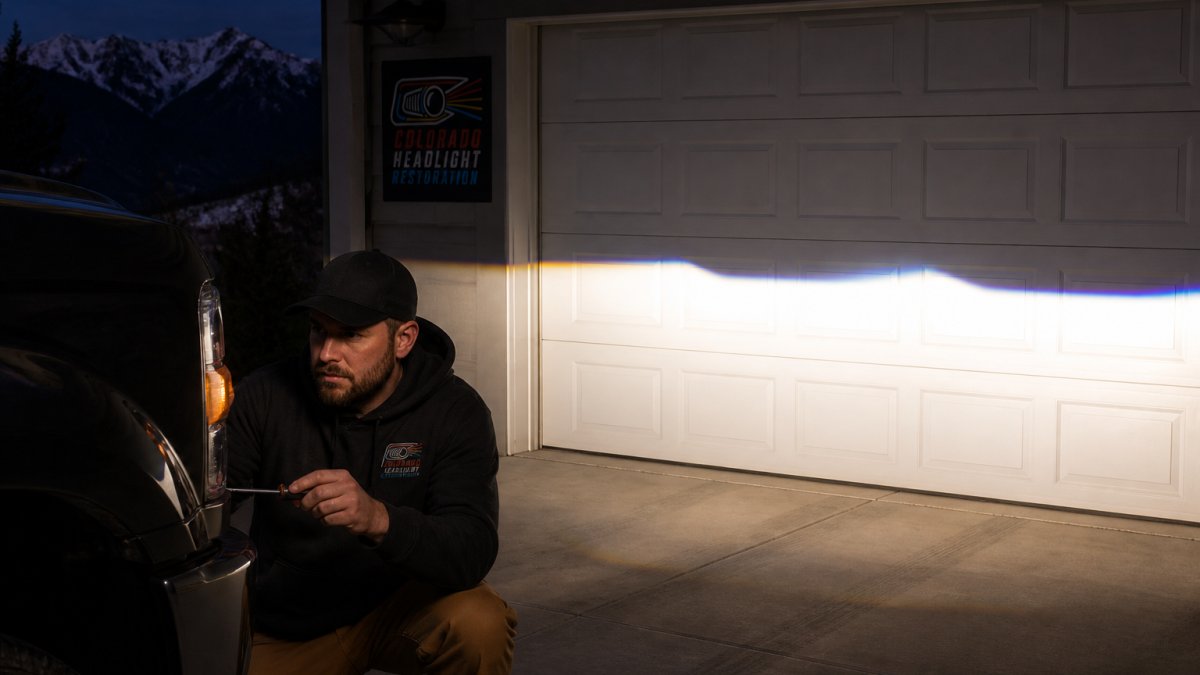
After any bulb swap, re-aim the lights. Park on level ground facing a wall, mark the cutoff height, and adjust until both beams sit level and slightly below center.
For a deeper look at reducing glare and improving night vision, read our guide on how to improve night driving visibility.
Snow, Fog, Rain, and Cold: Mountain Weather Performance
Most headlight advice treats brightness as the only measure. In mountain weather, brightness is often the problem. Snow, fog, and heavy rain reflect light back at the driver, so a scattered or overly bright beam turns a snowstorm into a whiteout. This section covers what actually changes visibility when the weather turns.
Why beam pattern beats raw output in weather
A tight cutoff and controlled beam keep light on the road and out of the weather. When light leaves the intended pattern, it hits falling snow, fog droplets, or rain and scatters back into your eyes. That is why a dimmer, well-aimed halogen can outperform a brighter, poorly aimed LED in a snowstorm. The fix is less stray light, not more light.
Color temperature and contrast
Color temperature changes how a beam reads against snow and fog. A neutral white in the 5000K to 6000K range is a good general choice for dark pavement and snow banks. Very blue bulbs scatter more in fog and snow because short wavelengths bounce off droplets, and they can wash out the road edge. A selective-yellow fog light improves contrast against snow and reduces backscatter in fog, though it is not a substitute for a proper fog-lamp pattern.
Snow and ice buildup on the lens
Halogen bulbs run hot at the lens and melt snow and ice that accumulates while driving. LED retrofits run cooler because heat moves to the back of the bulb, so in wet snow or freezing fog, ice can build up and block the beam. Clear lenses help in every condition, which is why we point drivers to why headlight clarity matters for emergency visibility when weather turns fast.
Fog, rain, and blowing snow
- Fog: Use a low, wide fog-lamp pattern and keep the low beam aimed low. High beams make fog worse by lighting the droplets in front of you.
- Heavy rain: A sharp cutoff and white beam read well on wet pavement, but watch for glare from oncoming traffic. Re-aim after any bulb swap.
- Blowing snow: Contrast matters more than brightness. A neutral white low beam with a clean cutoff and a yellow fog light is a common mountain setup.
Cold-weather durability and electrical behavior
Cold affects more than the lens. Halogen filaments are vulnerable to vibration and voltage spikes, and output fades over time. LEDs have no filament, but drivers and fans can be sensitive to moisture and cold. Look for a sealed driver, a rated operating temperature covering your winter lows, and a housing that sheds water. Some LEDs draw less current than the factory system expects, triggering bulb-out warnings or flicker; a CANbus-ready kit or inline resistor resolves most cases.
A quick weather checklist
- Aim the lights after any swap and confirm the cutoff sits below oncoming mirrors.
- Keep the low beam white and use a yellow fog light for snow and fog.
- If you drive winter passes, weigh halogen's snow-shedding against LED output.
- Clear cloudy lenses before upgrading bulbs; a yellowed housing scatters light in every condition.
- Confirm the bulb is rated for cold and vibration, and that any driver or fan clears the housing.
The best mountain-weather setup is not the brightest one. It has a clean cutoff, the right color for the conditions, and a lens that lets the light through.
Legal Compliance and Road-Use Approval for Aftermarket Bulbs
Aftermarket bulbs must meet federal lighting standards to be legal for road use. The FMVSS 108 lighting standard from NHTSA governs headlamp performance, and many states add their own inspection rules.
Before buying, confirm the bulb is DOT-compliant for your housing, keep the color temperature in the white range, and avoid extreme-output claims. Colorado vehicle inspections can flag non-compliant lighting, so compliance protects your wallet as well as other drivers.
Book a Headlight Clarity Check Before Your Next Mountain Drive
New bulbs cannot fix a cloudy lens. If your headlights look yellowed or hazy, restoration is the higher-value first step. Our mobile service comes to your home or office, restores OEM clarity in 30 to 60 minutes, and applies a ceramic UV sealant built to handle high-altitude sun for up to three years.
Not sure when to schedule? Our headlight maintenance schedule for Colorado vehicles shows when inspection and restoration are due. Get started with Colorado Headlight Restoration and see the road clearly on your next mountain drive.
Frequently Asked Questions
What headlight bulbs are best for mountain driving?
There is no single best bulb, but the strongest options for mountain driving pair good beam distance with controlled cutoff. Halogen upgrades like Sylvania XtraVision and Philips CrystalVision Ultra keep stock beam patterns and are simple drop-in swaps. LED options such as SEALIGHT X1 and LASFIT LSplus can deliver more light output, but only if the bulb is compatible with your housing and aimed correctly. On steep grades and switchbacks, beam pattern and aim matter more than raw brightness.
Are LED or halogen bulbs better for driving on dark mountain roads?
LED bulbs typically produce more light output and a whiter color temperature, which can improve road illumination on unlit mountain roads. Halogen bulbs cost less, run hotter (which helps melt snow off the lens), and keep the factory beam pattern with no compatibility guesswork. In projector housings, a well-matched LED kit can outperform halogen. In reflector housings, poorly matched LEDs scatter light and cause glare, so fitment and aiming decide which is actually better for your truck.
Can aftermarket LED bulbs be used in a halogen headlight housing?
They can be installed, but results vary. A halogen reflector housing is designed around the filament position of a halogen bulb, so an LED that does not match that position can throw light outside the intended beam pattern, creating glare for oncoming traffic and reducing your own visibility. Check that the bulb is listed as compatible with your specific housing type, confirm the bulb size for your model year, and re-aim the headlights after installation. Projector housings generally accept LED upgrades more predictably.
Can cloudy headlights reduce nighttime visibility?
Yes. Oxidized, yellowed lenses block and scatter light before it ever leaves the housing, so even new bulbs cannot fix a dim, fuzzy beam. If your lenses look cloudy, restoring clarity first gives you a measurable gain in road illumination. A professional restoration with a UV sealant protects the lens from further oxidation, and it costs far less than replacing the assemblies, which makes it a sensible first step before spending on bulb upgrades.
Mountain nights do not forgive dim, scattered light. If your lenses are clouded or your beams are aimed wrong, fix the clarity first, then choose the bulb that matches your Colorado's housing. Get started with Colorado Headlight Restoration and book a mobile restoration that restores OEM clarity, adds years of UV protection, and puts usable light back on the road.

Learn more about our headlight restoration in Denver, or see headlight restoration in Longmont.
Cloudy headlights? Get your price in 30 seconds.
Mobile service across the Denver metro. Most vehicles finished in 30–60 minutes, right in your driveway.